
The VA isn't just deciding whether you're hurt. They're deciding whether your file proves three things.
Understand The Three Elements Needed in ANY VA Disability Claim Before You Make Your Next Move...

Understand The Three Elements Necessary for the VA to Grant Service Connection.
VA disability claims run on rules, evidence standards, examinations, and review options that nobody explains to you. This guide shows you how those pieces fit together — without promising a rating, selling representation, or taking a percentage of your benefits.
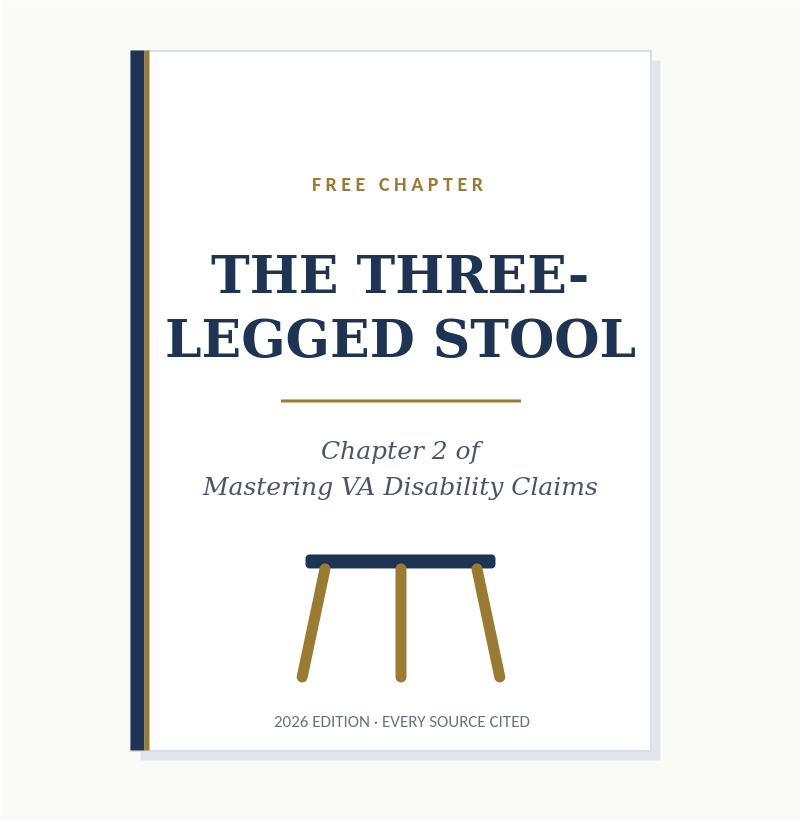
Chapter 2 is free, and it's the chapter everything else is built on.

You did the paperwork. You still don't know what's happening.
You filed, or you're about to. Somewhere in there it stopped making sense.
A letter arrived saying the evidence doesn't establish a nexus, and nobody told you what a nexus is. You sat through a twenty-minute exam and walked out unsure what had just been decided. You've read the same VA.gov page four times. Someone in a Facebook group says you should be at 70 percent. Someone else says don't file at all or they'll cut your retirement.
And there's a company running ads promising to get you rated, for a fee calculated as a multiple of your monthly increase — so the more your claim turns out to be worth, the more they take.
Here's what's actually going on.
The VA is not measuring how much you're suffering. It is checking whether particular findings appear in your file — specific measurements, specific frequencies, specific words — against criteria published in federal regulation.
Those criteria are public. They're just written for adjudicators rather than for you, and nobody at VA has the time to sit down and walk you through them.
That's the whole problem. It's also a solvable one.
Did you know?
Every Claim Stands on Three Legs
Picture your claim as a three-legged stool. Each Leg is something you have to prove. If one is missing, the stool falls over. No matter how strong the other two are.
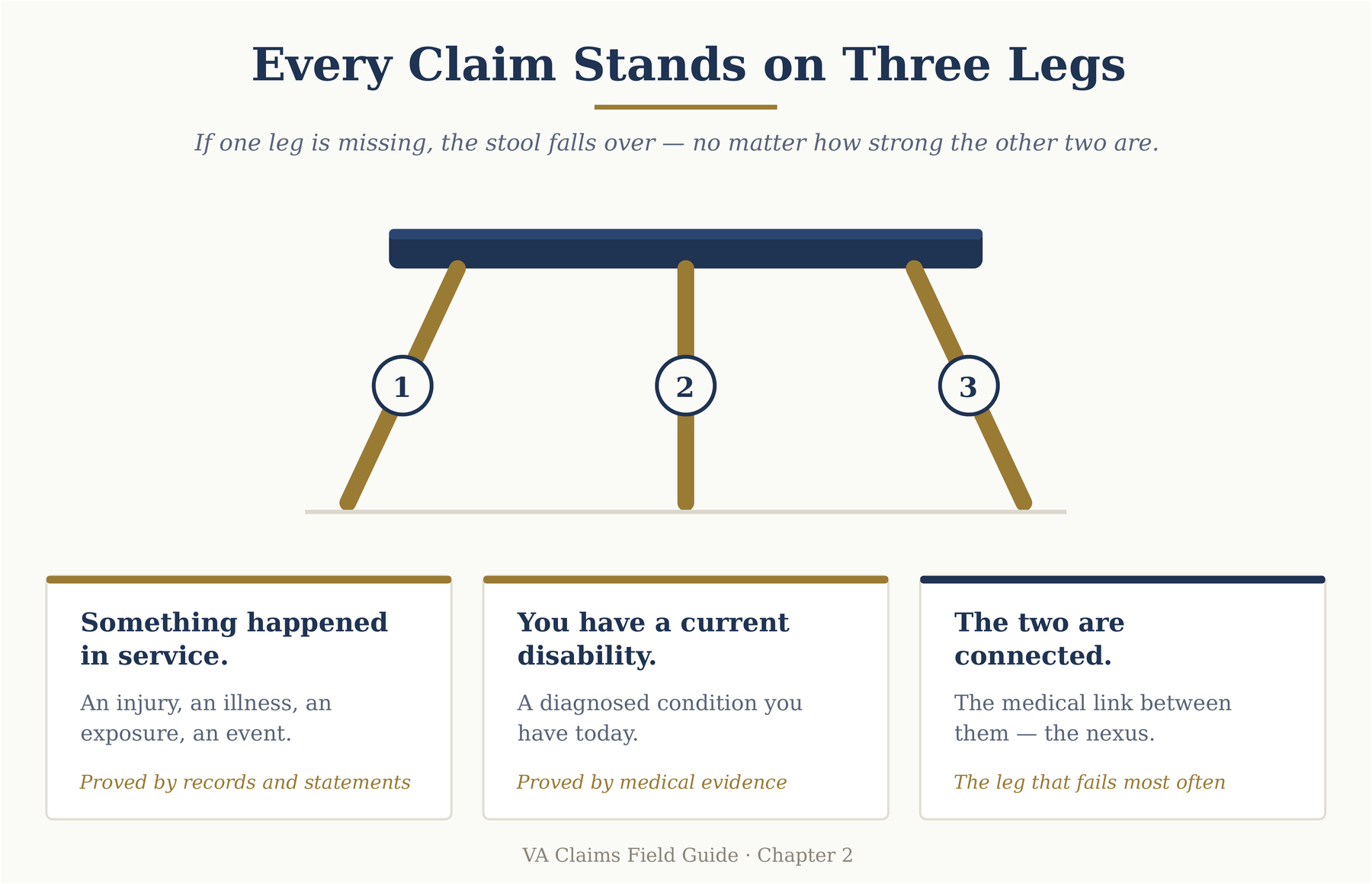
One. Something happened in service. An injury, an illness, an exposure, an event.
Two. You have a current disability. Medical evidence can help establish the condition you have today and how it affects you.
Three. The two are connected. A medical link between them. This is the leg that fails most often, and it's the one nobody warns you about.
Once you see it that way, your denial letter becomes readable.
"No evidence of a current disability" means leg two. "The evidence does not establish a link to service" means leg three — and there are five separate ways to build that leg, one of which needs no doctor's opinion at all.
Most veterans never learn that. They read a denial as a verdict on whether they were telling the truth, when it was only ever a note about which of three boxes was empty.
That's Chapter 2. It's free — link at the bottom of this page. Everything else in the guide is built on it.
The VA Claims Field Guide
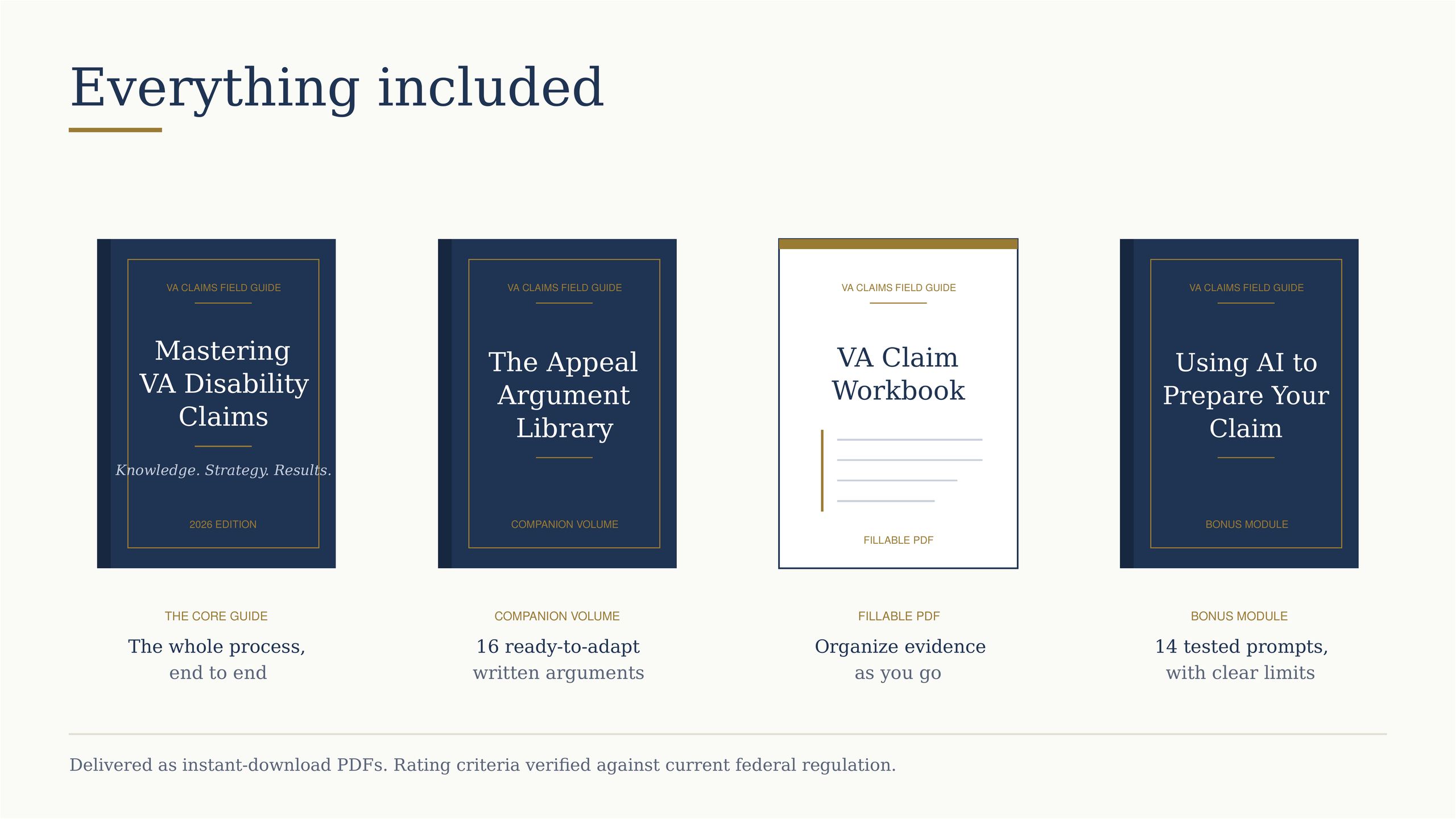
113 pages, five parts, and a toolkit
Part One — Foundations. What the benefit actually is, who qualifies, and how combined ratings are calculated — which is not addition, and that surprises nearly everyone. Then the three-legged stool the rest of the guide is built on, and which claim type you should actually be filing.
Part Two — Building the Claim. Seven kinds of evidence and how to get each one. A systematic sweep for the conditions veterans routinely fail to claim, especially secondaries — the largest source of unclaimed benefit in the system. How to describe a condition on the form so it gets evaluated the way you meant it. And a full chapter on the C&P exam, which decides more of your rating than anything else you do.
Part Three — After the Decision. How to read a rating decision, including the section almost nobody reads: the one listing findings VA has already made in your favor, which are permanent and never have to be proven again. The three appeal lanes and how to choose between them, because choosing wrong costs a year. A table matching every common denial reason to the specific document that answers it. Then increases, TDIU, and the Special Monthly Compensation most veterans never claim.
Part Four — Beyond the Monthly Check. A rating is a key, not just a payment. Education and employment benefits, adapted housing grants, health care priority, benefits for your spouse and children, and the state-level exemptions that are frequently worth more than a rating tier. Then how to find help you can trust — the three kinds of people who may lawfully represent you, what they may and may not charge you, and how to verify anyone's credentials in a public database before you sign anything.
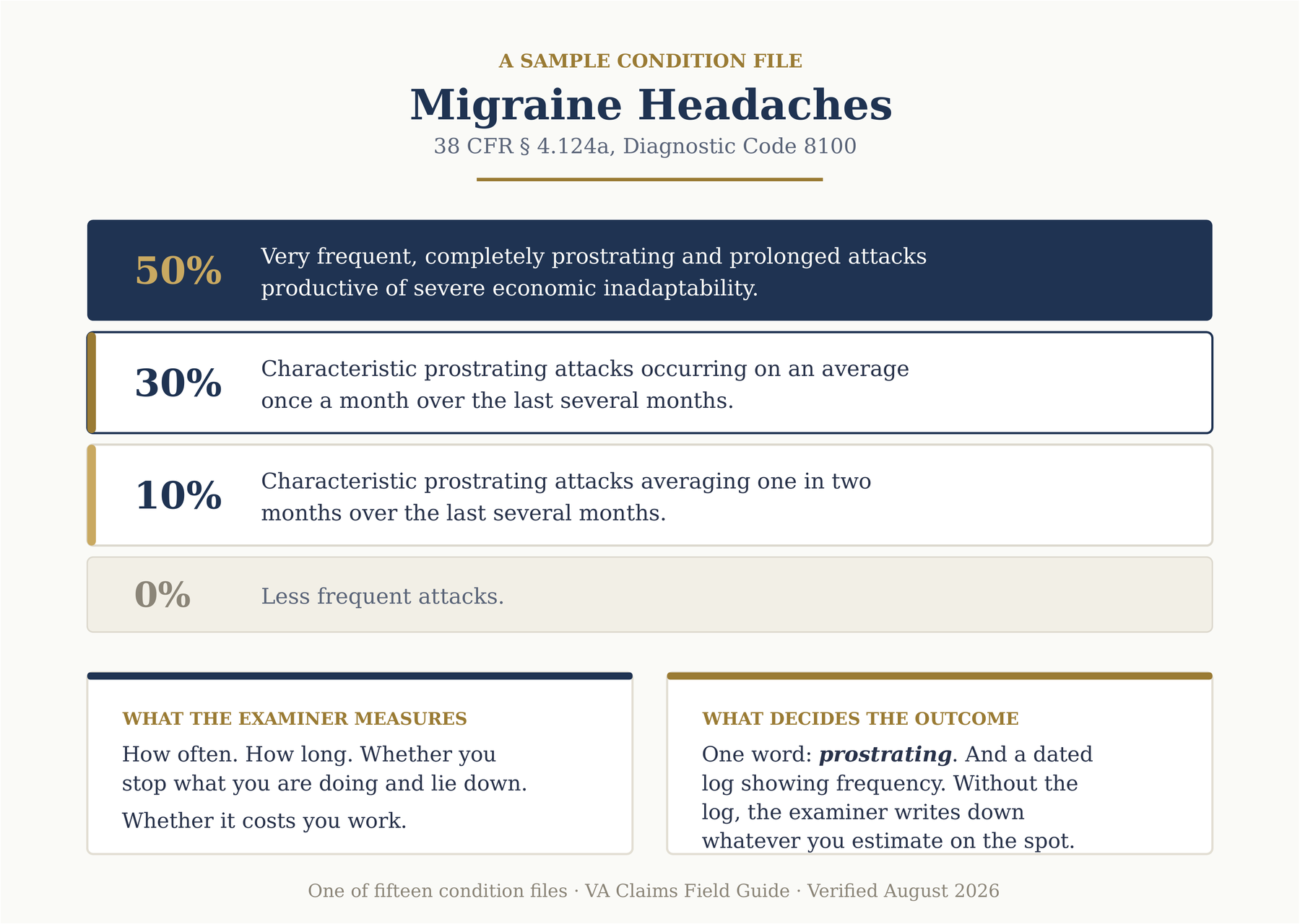
Part Five — The Condition Files. Fifteen of the most-claimed conditions, one file each. The diagnostic code, the rating ladder from 38 CFR Part 4 in plain language, what the examiner will be measuring in the room, and the two or three things that actually decide the outcome. Read the one that applies to you before your exam.
The Toolkit. Nine appendices, all built to be printed and handed to someone. A personal statement template. A buddy statement template. A letter you hand your doctor explaining exactly what a nexus opinion has to say, and why "may be related" is worth nothing. A readiness checklist, a C&P prep worksheet, a symptom diary, a forms reference, a glossary, and a contact directory.
Plus, the fillable workbook - every template as a PDF you can type into and save or print and write on.
$89 through December 31, 2026.

The Part Nobody Gives You
Your rating isn't a judgment call. It's a checklist in federal regulations, and every condition has one.
A back rating turns on how many degrees you bend forward — the difference between 20% and 40% can be several degrees on a goniometer. A migraine rating turns on one word, "prostrating," and how often. Since May 2024, an IBS rating is determined by how many days per month you have abdominal pain related to a bowel movement — which means a dated log directly determines your percentage.
Almost no veteran knows this. The criteria are public, in 38 CFR Part 4, but they're written for adjudicators. So here they are in plain language, for fifteen conditions: tinnitus, hearing loss, PTSD and mental health, lumbar and cervical spine, radiculopathy, knees, migraines, sleep apnea, GERD, IBS, rhinitis and sinusitis, scars, diabetes, hypertension, and erectile dysfunction.
One page each. The rating ladder, what the examiner measures, what moves the rating, what sinks it, and which secondary conditions to look at next.
Take the right page to your exam.
Don't take anyone's word for it.
Every criterion in this guide indicates its source: 38 CFR Parts 3 and 4, 38 U.S.C. § 5107(b), VA.gov, and the Federal Register. Look them up. That's the point of citing them.
That's not how most VA claim content works. Most of it is somebody's summary of somebody else's summary, and errors propagate quietly for years.
Which is why so much of what you'll find is out of date.
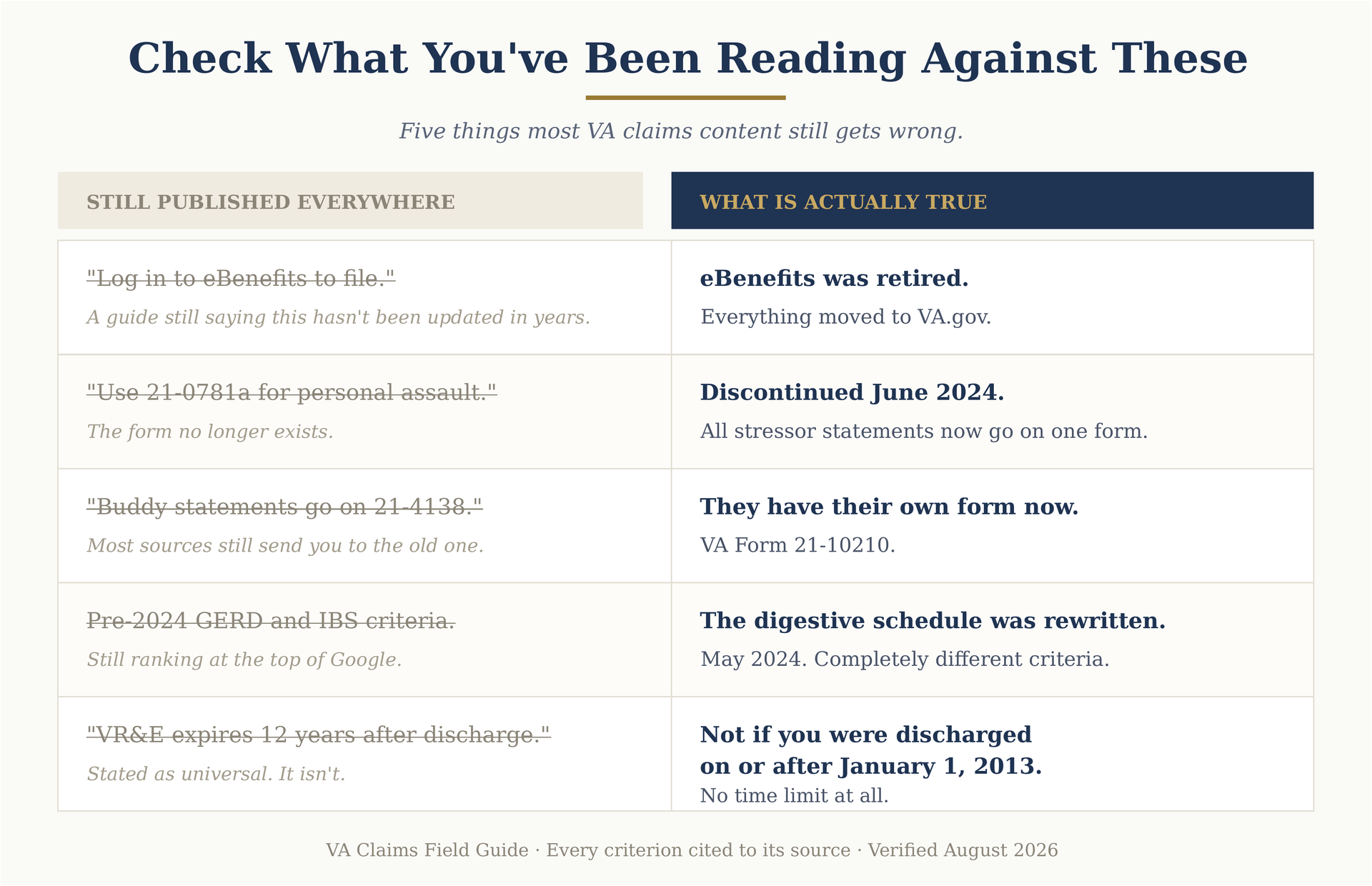
Check whatever you've been reading against these:
- eBenefits was retired. Everything moved to VA.gov. A guide still telling you to log in there hasn't been updated in years — which tells you what to assume about the rest of it.
- VA Form 21-0781a was discontinued in June 2024. All mental health stressor statements now go on one form.
- Buddy statements have their own form, 21-10210. Most sources still send you to the old one.
- The digestive system rating schedule was rewritten in May 2024. GERD and IBS are now rated on completely different criteria than they were two years ago.
- The VR&E twelve-year deadline no longer applies to anyone discharged from active duty on or after January 1, 2013. If you were discharged before that date, the twelve-year clock still runs — but it can be extended for a serious employment handicap, which most sources never mention.
This guide flags all of it and includes a Watch List of rating changes that have been proposed but are not yet law — for sleep apnea, tinnitus, and mental health — so you can tell the difference between what's real and what's a headline somebody is using to rush you.
Who is This For?
This is for you if:
- You're filing for the first time and don't know where to start
- You have a denial letter and can't tell what it's actually saying
- You're already rated and suspect you left something on the table
- Your condition got worse and you don't know whether that's enough for an increase
- You're a spouse, a caregiver, or a volunteer helping someone through it
This isn't for you if:
- You want someone to file it for you. That's what an accredited representative does, and this guide shows you how to find one for free.
- You want a guaranteed rating. Nobody can promise that. Anyone who does is telling you something about themselves.
- You want a shortcut. There isn't one. There's just knowing what the system needs and giving it to them.
What this costs, and what the alternative costs
You've probably seen the ads. Companies that will "maximize your rating" for a fee charged as a multiple of your first month's increase. The larger the award, the larger their cut — for filing forms an accredited representative would have filed for free.
This is the opposite of that business. One price, paid once, and you keep every dollar the VA sends you.
The VA Claims Field Guide
- The complete 113-page guide, including all fifteen condition files
- The fillable companion workbook — every template, typed into and saved
- The current rate sheet insert
- Instant download. Yours to keep, on any device, forever.
$89 through December 31, 2026.
One payment. No subscription, no upsell sequence, no percentage of your benefits — not now, not ever.
GUARANTEE
Thirty days. No questions.
If it doesn't make this clearer, email us and we'll refund you. You don't have to explain and you don't have to send anything back — it's a PDF, we couldn't take it back if we wanted to.
What we won't guarantee is a claim outcome. Nobody honestly can. The VA decides your claim. What we guarantee is the guide.
FAQs
Isn't all of this free on VA.gov?
Yes, and we cite it throughout so you can check us. The information was never hidden — it's spread across hundreds of pages organized the way the agency thinks, not the way you're deciding what to do next. This is the same information, sequenced in the order you actually need it.
I already have a VSO. Do I need this?
Get a VSO. The guide tells you how to find one, and it costs nothing. But your representative is carrying hundreds of cases. They'll file your paperwork correctly. They won't have an hour to explain what the examiner is measuring, or why the wording of a doctor's letter can decide the claim. That's the gap this fills. A veteran who understands the process is a better client for their representative, not a replacement for one.
Who wrote this?
This guide is published without a byline, and we'd rather tell you that plainly than dress up an author bio. Judge it the way you'd judge any reference: check the sources. Every criterion in the guide cites the regulation it came from, and Chapter 2 is free so you can read a full chapter before you decide. If it doesn't hold up, don't buy it — and if you do buy it and it doesn't, there's a thirty-day refund.
Do you file the claim for me?
No. Preparing and presenting claims requires VA accreditation, and that isn't what this is — it's an educational guide. Chapter 12 shows you how to find free, accredited help and how to verify anyone before you sign a thing.
Why does it cost $89?
Because it's a book, not a service. One payment, fixed — unlike the unaccredited consultants who take a percentage of your back pay, so the bigger your claim, the more they take.
You should still use a free VSO; the guide tells you how to find and verify one. This is what makes you useful in that meeting: knowing your diagnostic code, which part of your claim is weak, and which appeal lane fits your denial.
Chapter 2 is free in full, and there's a thirty-day refund.
Is it current?
Verified through August 2026, with every source cited. Rating criteria change — the digestive schedule was rewritten in 2024, and the guide includes a Watch List of proposed changes that aren't law yet. Rates update every December, and we send the new sheet to everyone.
I'm not good with computers.
It's a PDF. It opens on a phone, tablet, or computer, and then prints. The workbook can be typed into or printed and filled in by hand.
Can my wife use this to help me?
Yes, and plenty of people buy it for exactly that. The templates are built to be handed to someone else, including the buddy statement form and the letter you give your doctor.
What if it doesn't help?
Thirty-day refund, no questions.
One last thing...
If you buy nothing today, do this anyway: go to VA.gov and file an Intent to File. Form 21-0966. Ten minutes, free, obligates you to nothing. Or call the VA at 1-800-827-1000 and tell them you wish to start an Intent to File a claim for disability compensation.
It locks your effective date for twelve months, which means every week you spend afterward gathering evidence is back pay you keep instead of lose. Veterans lose thousands of dollars every year because nobody told them to do it first.
Now you've been told.
$89 through December 31, 2026.
VA Claims Field Guide is a private educational publisher. We are not affiliated with, endorsed by, or sponsored by the U.S. Department of Veterans Affairs or any government agency. We do not prepare, present, or prosecute claims for VA benefits and we are not a substitute for a VA-accredited representative, whose services are free. Nothing here is legal or medical advice, and no outcome is guaranteed.
In crisis? Call 988 and press 1, text 838255, or chat at VeteransCrisisLine.net. 24/7, no enrollment required.
© 2026 VA Claims Field Guide. All Rights Reserved.