
Reductions · October 2026
VA Proposed Rating Reduction: Deadlines, Protections and What to Check in the Letter
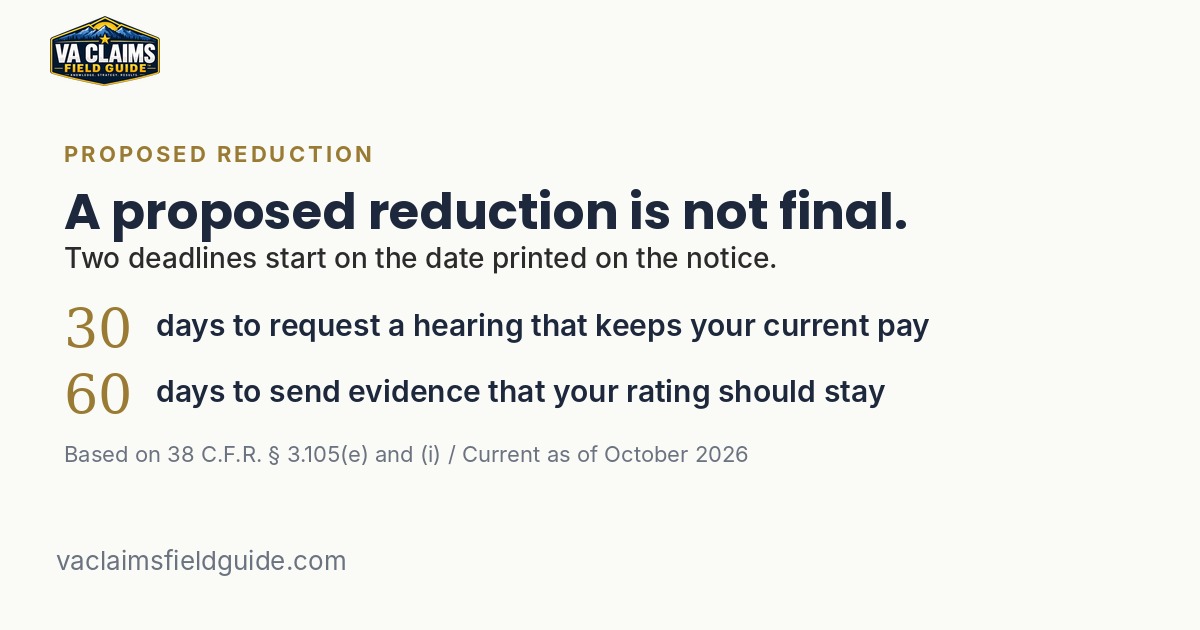
Short answer: A VA proposed rating reduction is a proposal, not a final decision. The letter starts two clocks on the date printed on it: 30 days to request a predetermination hearing, which keeps your current payments in place while it is pending, and 60 days to send evidence that the rating should stay where it is (38 C.F.R. 3.105(e) and (i)).
Ratings held for 5, 10 or 20 years carry extra protection, and VA's own Inspector General found errors in about 34% of the 2024 reduction cases it reviewed. Read the letter closely before you assume it is right.
What is a VA proposed rating reduction?
When VA thinks a service-connected condition has improved, and lowering the rating would reduce or stop payments you are receiving now, it can't simply cut the rating. Under 38 C.F.R. 3.105(e), VA must first prepare a rating "proposing the reduction or discontinuance," setting out all the material facts and reasons, and send you notice.
That notice is the letter you're holding. Nothing has changed in your payments yet. The rule exists so you can respond before anything does.
Reductions often start with a routine re-examination. If the exam behind the proposal was short, skipped important tests or ignored your history, that matters. Our guide to a bad C&P exam explains how to get a copy and what makes an exam inadequate.
What are the deadlines in a VA proposed rating reduction letter?
There are two, and both run from the date on the notice, not the day you opened it.
- 30 days to request a predetermination hearing. Under 3.105(i), if VA receives your request within 30 days, benefit payments continue at the current level until VA makes a final decision. The hearing is held by VA personnel who did not take part in the proposed action.
- 60 days to send evidence. Under 3.105(e), you have 60 days to submit evidence showing the rating should continue. If VA receives nothing, it can finalize the reduction, and the lower rating takes effect at the end of the month in which the 60-day period ends.
The common mistake is planning around the 60 days and missing the 30. If you want a hearing and want your pay protected while you wait, the 30-day date is the one to circle.
Which VA ratings are protected from reduction?
Time matters. The regulations add protection the longer a rating or service connection has been in place.
| How long | Protection | Rule |
|---|---|---|
| Rating at the same level 5+ years | VA must handle it for "the greatest degree of stability." A less thorough exam can't be the basis for reduction, and a condition with episodic improvement can't be cut on one exam unless the evidence shows sustained improvement that will likely hold up in ordinary life. | 38 C.F.R. 3.344(a), (c) |
| Service connection 10+ years | Service connection itself can't be severed except for fraud, or when military records clearly show the required service or discharge was lacking. (The percentage can still change.) | 38 C.F.R. 3.957 |
| Rating at or above a level 20+ years | Can't be reduced below that level except for fraud. | 38 C.F.R. 3.951(b) |
| Any rating, after a rating-schedule change | A change to the rating schedule alone is not a reason to reduce. VA needs medical evidence of actual improvement. | 38 C.F.R. 3.951(a) |
A rating held for less than five years can be reduced on a re-exam showing improvement, but VA still has to follow the notice rules above.
Can VA reduce a 100% rating?
Yes, but the bar is higher. Under 38 C.F.R. 3.343(a), a total rating can't be reduced without an examination showing "material improvement," and VA has to consider whether you improved under the "ordinary conditions of life," meaning while working or actively looking for work.
For a total rating based on individual unemployability (TDIU), 3.343(c) requires "clear and convincing evidence" of actual employability. A veteran who began substantially gainful work can't lose TDIU for that reason alone unless the job lasts 12 consecutive months.
What should I check in the letter?
- The date on the notice. Count 30 and 60 days from it. Write both dates down.
- The condition and diagnostic code. Make sure the proposal is about the condition you think it is, and that the code matches your rating decision.
- The evidence VA relied on. Usually one exam. Compare it with your treatment records. Did it test what the rating criteria require? Was it done during a good stretch of an up-and-down condition?
- How long you have held the rating. Check it against the 5-, 10- and 20-year rules above.
- Whether payments would actually drop. 3.105(e) applies when the lower evaluation would reduce or stop payments currently being made. If your combined rating would stay the same, ask a VSO how the notice rules apply.
How do I respond to a VA proposed rating reduction?
Put your hearing request in writing and make sure VA receives it inside 30 days. Then use the 60 days to build the record. Evidence that tends to matter:
- Recent treatment records showing current symptoms, not just your best day.
- A statement from your own provider that addresses the rating criteria for your diagnostic code.
- Your own statement, and statements from people who see you every day, about how the condition affects work and daily life.
- Anything showing the improvement is temporary, such as flare-ups or a medication change.
An accredited VSO can help you respond at no cost. If you already have a representative, call them the day the letter arrives.
What did VA's Inspector General find about reductions?
In Report 25-01011-154 (August 31, 2026), VA's Office of Inspector General found that claims processors made one or more errors in about 34% of cases involving proposed and final reductions of service-connected compensation in calendar year 2024. The error types included insufficient notice before the action, outdated codesheets and improper effective dates. The OIG also found cases where VA failed to take an adverse action it should have, so errors cut both ways.
That finding doesn't mean any given proposal is wrong. It does mean the letter deserves a careful read, line by line.
What if VA finalizes the reduction anyway?
You can still challenge it. A final reduction is a decision you can take to a Supplemental Claim (new evidence), a Higher-Level Review (no new evidence; a senior reviewer looks for errors, such as ignoring 3.344), or the Board. File within one year to protect your effective date. Our guide to choosing a review lane and the deadlines explains which fits.
Worried that proposed changes to the rating schedule could trigger a reduction? A schedule change alone can't (3.951(a)). Our page on the VA sleep apnea rating changes explains where those proposals stand.
VA proposed rating reduction: common questions
Is a VA proposed rating reduction final?
No. It is a proposal. You have 30 days from the notice date to request a predetermination hearing and 60 days to send evidence before VA can make it final (38 C.F.R. 3.105(e), (i)).
Will my payments drop right away?
No. Payments continue at the current rate during the 60-day period. If VA receives a hearing request within 30 days, payments continue at the current level until VA makes a final decision (38 C.F.R. 3.105(i)).
Can VA reduce a rating I have had for more than 5 years?
It can, but 38 C.F.R. 3.344 adds protection: VA can't rely on a less thorough exam, and for conditions that come and go it needs evidence of sustained improvement likely to hold in ordinary life.
Can VA take away service connection after 10 years?
Generally no. Under 38 C.F.R. 3.957, service connection in effect for 10 years or more can't be severed except for fraud or when military records clearly show the required service or discharge was lacking. The rating percentage can still change.
What is the 20-year rule?
Under 38 C.F.R. 3.951(b), a rating held continuously at or above a level for 20 years or more can't be reduced below that level except for fraud.
Read your file the way a rater does
A reduction usually turns on one exam and how it lines up with the rating criteria. Chapter 2 shows the framework VA applies to every claim, with the regulation behind each step.
Read Chapter 2 free Learn More About the Full GuideSources
- 38 C.F.R. 3.105, Revision of decisions (paragraphs (e) and (i)): ecfr.gov
- 38 C.F.R. 3.343, Continuance of total disability ratings: ecfr.gov
- 38 C.F.R. 3.344, Stabilization of disability evaluations: ecfr.gov
- 38 C.F.R. 3.951, Preservation of disability ratings: ecfr.gov
- 38 C.F.R. 3.957, Service connection: ecfr.gov
- 38 C.F.R. 3.2500, Review of decisions: ecfr.gov
- VA OIG Report 25-01011-154, Review of VBA's Processing of Adverse Actions for Service-Connected Disability Compensation (Aug. 31, 2026): vaoig.gov (PDF)
Education, not legal advice. VA Claims Field Guide is not affiliated with the U.S. Department of Veterans Affairs. Accredited Veterans Service Organizations (VSOs) file claims at no cost. Last verified October 24, 2026 (eCFR current as of October 22, 2026).
VA Claims Field Guide is a private educational publisher. We are not affiliated with, endorsed by, or sponsored by the U.S. Department of Veterans Affairs or any government agency. We do not prepare, present, or prosecute claims for VA benefits and we are not a substitute for a VA-accredited representative, whose services are free. Nothing here is legal or medical advice, and no outcome is guaranteed.
In crisis? Call 988 and press 1, text 838255, or chat at VeteransCrisisLine.net. 24/7, no enrollment required.
© 2026 VA Claims Field Guide. All Rights Reserved.