
VA Sleep Apnea Rating Changes: What Is Proposed, What Is Law, and Who Is Protected
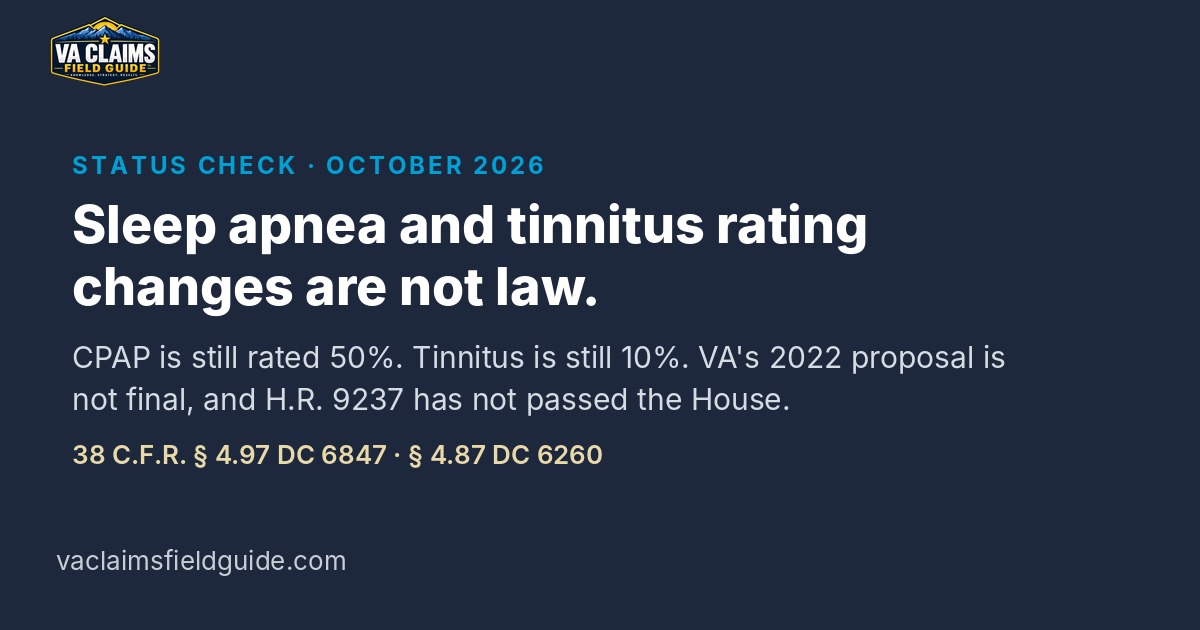
The VA sleep apnea rating changes you keep reading about are not in effect. As of October 17, 2026, VA still rates sleep apnea that requires a CPAP machine at 50 percent under 38 CFR 4.97, diagnostic code 6847, and still rates recurrent tinnitus at 10 percent under diagnostic code 6260.
Two separate proposals would change that for future claims: a VA proposed rule from February 2022 that is not final, and Section 108 of a House bill (H.R. 9237) that has not passed. Both, as written, protect ratings veterans already have.
Are the VA sleep apnea rating changes in effect yet?
No. A rule is only law once VA publishes a final rule in the Federal Register and its effective date arrives, or once Congress passes a bill and the President signs it. Neither has happened. The current rating criteria for sleep apnea are the ones printed in 38 CFR 4.97 today:
| Rating | Current criteria, DC 6847 (in effect now) |
|---|---|
| 100% | Chronic respiratory failure with carbon dioxide retention or cor pulmonale, or requires tracheostomy |
| 50% | Requires use of a breathing assistance device such as a CPAP machine |
| 30% | Persistent daytime hypersomnolence |
| 0% | Asymptomatic but with documented sleep disorder breathing |
Tinnitus is still rated at a single 10 percent under DC 6260 in 38 CFR 4.87, no matter whether it is heard in one ear, both ears or the head.
So the answer to "does CPAP still get 50 percent?" is yes, for any claim VA decides under the current schedule.
What did VA propose in 2022?
On February 15, 2022, VA published a proposed rule rewriting the ear, nose, throat, audiology and respiratory sections of the rating schedule (87 FR 8474, RIN 2900-AQ72). The comment period closed April 18, 2022. For sleep apnea, the proposal would rate the condition by how well treatment works instead of by the type of treatment:
- 0% if sleep apnea is asymptomatic, with or without treatment
- 10% if treatment gives incomplete relief
- 50% only if treatment is ineffective or the veteran cannot use the prescribed treatment because of other conditions
- 100% only with end-organ damage
For tinnitus, VA proposed deleting DC 6260 and rating tinnitus as a symptom of the condition causing it, such as hearing loss or a traumatic brain injury. Hearing loss under DC 6100 would get a 10 percent evaluation when tinnitus comes with hearing loss that is otherwise rated at 0 percent.
Where it stands: VA's most recent regulatory agenda lists RIN 2900-AQ72 at the final rule stage with a target of April 2027. Agenda dates are planning targets, not commitments. An earlier agenda listed December 2025, and that date passed without a final rule. Until a final rule is published, nothing in the 2022 proposal applies to anyone.
What would Section 108 of H.R. 9237 do?
H.R. 9237, the Take Care of America's Veterans Act, was introduced in the House on June 10, 2026. Section 108 of the introduced bill would write rating rules for sleep apnea and tinnitus directly into law:
- Sleep apnea: 0 percent when asymptomatic, 10 percent when treatment gives incomplete relief, 50 percent only if treatment is ineffective or can't be used because of other conditions and there is no end-organ damage, and 100 percent only with end-organ damage. That mirrors VA's 2022 proposal.
- Tinnitus: no separate compensable rating, except 10 percent when tinnitus is associated with service-connected hearing loss that is otherwise noncompensable.
- Who it covers: the bill text says the changes apply "with respect to claims filed after the date of the enactment," and may not be used to reduce, discontinue or otherwise adversely affect compensation in effect the day before enactment.
Where it stands: the bill has not passed the House. The only recorded floor vote, on July 16, 2026, was a motion to recommit, which failed 210 to 211; there has been no vote on passage. To become law it would still need to pass both chambers and be signed. Congress is expected back after the November 3 election, so watch for it in any year-end package.
If I already have a 50% sleep apnea rating, can VA lower it?
Not because of a rating schedule rewrite alone. 38 CFR 3.951(a) says a readjustment to the rating schedule "shall not be grounds for reduction of a disability rating in effect on the date of the readjustment unless medical evidence establishes that the disability to be evaluated has actually improved." In the 2022 proposal, VA said the tinnitus change would have no impact on veterans already service connected for tinnitus under DC 6260, because those ratings are governed by 3.951(a). And as quoted above, Section 108 of H.R. 9237 protects compensation already in effect.
Three more protections apply no matter what happens to these proposals:
- A rating held at or above a level for 20 or more years generally cannot be reduced below that level, except for fraud (38 CFR 3.951(b)).
- Ratings in place for five years or more get extra protection against reduction based on a single exam (38 CFR 3.344).
- VA must send a proposed reduction and give you time to respond before it cuts any rating. Our guide to a VA proposed rating reduction covers the 30-day and 60-day deadlines.
One honest caveat: Congress can write different rules into a statute. The protection in Section 108 exists because the bill's authors included it. If a different version passes, read its applicability language before assuming anything.
Should I file my sleep apnea or tinnitus claim now?
File when your evidence is ready, not out of fear. Under today's rules, a sleep apnea claim needs a current diagnosis, an in-service event or a service-connected condition that caused or worsened it, and a medical opinion linking the two. Many veterans claim sleep apnea secondary to a service-connected condition under 38 CFR 3.310, which makes the medical opinion the deciding document.
If you need time to gather records, an intent to file preserves your potential effective date for one year while you finish the claim (38 CFR 3.155(b)). Under H.R. 9237 as introduced, the date that matters is when the claim is filed, not when it is decided. Under VA's proposal, the final rule itself will state when and how it applies, and that text does not exist yet.
If you were already denied, the problem is almost always evidence, not the pending proposals. Our breakdown of Supplemental Claim vs. Higher-Level Review vs. Board appeal explains which lane fits which mistake, and what to do after a bad C&P exam covers the most common one.
How do sleep apnea and tinnitus ratings fit into my combined rating?
Each rating is combined with your others using VA's combined ratings table, not added. A 50 percent sleep apnea rating combined with a 10 percent tinnitus rating is 55, which rounds to 60 percent. The math matters if you are close to a payment tier or to 100 percent. See how VA combined ratings are calculated for worked examples.
VA sleep apnea rating changes: common questions
Are the VA sleep apnea rating changes final?
No. As of October 17, 2026, VA has not published a final rule, and H.R. 9237 has not passed the House. Sleep apnea requiring a CPAP is still rated 50 percent under 38 CFR 4.97, DC 6847.
Will VA take away my tinnitus rating?
Not under either proposal as written. VA said its 2022 tinnitus change would not affect veterans already rated under DC 6260 (38 CFR 3.951(a)), and Section 108 of H.R. 9237 applies only to claims filed after enactment.
When could the sleep apnea rating changes take effect?
VA's regulatory agenda targets a final rule in April 2027, but agenda dates often slip. A final rule would state its own effective date. The House bill would take effect only if Congress passes it and the President signs it.
Does a CPAP still get a 50 percent VA rating?
Yes. The current criteria assign 50 percent when sleep apnea requires a breathing assistance device such as a CPAP machine.
Can VA lower my existing sleep apnea rating because of the new rules?
A schedule change alone is not grounds for a reduction unless medical evidence shows actual improvement (38 CFR 3.951(a)). Ratings held 20 years or more have additional protection under 3.951(b).
Building or fixing a claim now?
Chapter 2 of the guide walks through the three elements every service-connection claim has to prove, with the regulations behind each one. It is free.
Read Chapter 2 free Learn More About the Full GuideSources
- 38 CFR 4.97, DC 6847, current rating criteria (eCFR, current as of Oct. 14, 2026): https://www.ecfr.gov/current/title-38/chapter-I/part-4
- 38 CFR 4.87, DC 6260 tinnitus: https://www.law.cornell.edu/cfr/text/38/4.87
- 38 CFR 3.951, preservation of disability ratings: https://www.law.cornell.edu/cfr/text/38/3.951
- Proposed rule, Schedule for Rating Disabilities: Ear, Nose, Throat, and Audiology; Respiratory System, 87 FR 8474 (Feb. 15, 2022), RIN 2900-AQ72: https://www.govinfo.gov/content/pkg/FR-2022-02-15/html/2022-02049.htm
- Unified Agenda entry for RIN 2900-AQ72 (final rule stage, target 04/2027): https://www.reginfo.gov/public/do/eAgendaViewRule?pubId=202510&RIN=2900-AQ72
- H.R. 9237, Take Care of America's Veterans Act, introduced text, Sec. 108: https://www.govinfo.gov/content/pkg/BILLS-119hr9237ih/html/BILLS-119hr9237ih.htm
- House Roll Call 249, July 16, 2026 (motion to recommit H.R. 9237, failed 210-211): https://clerk.house.gov/Votes/2026249
- 38 CFR 3.344 and 3.105, reductions; 38 CFR 3.155, intent to file; 38 CFR 3.310, secondary service connection (eCFR Part 3): https://www.ecfr.gov/current/title-38/chapter-I/part-3
VA Claims Field Guide is not affiliated with the U.S. Department of Veterans Affairs. This article is education, not legal advice. Accredited Veterans Service Organizations (VSOs) help veterans file claims at no cost.
VA Claims Field Guide is a private educational publisher. We are not affiliated with, endorsed by, or sponsored by the U.S. Department of Veterans Affairs or any government agency. We do not prepare, present, or prosecute claims for VA benefits and we are not a substitute for a VA-accredited representative, whose services are free. Nothing here is legal or medical advice, and no outcome is guaranteed.
In crisis? Call 988 and press 1, text 838255, or chat at VeteransCrisisLine.net. 24/7, no enrollment required.
© 2026 VA Claims Field Guide. All Rights Reserved.